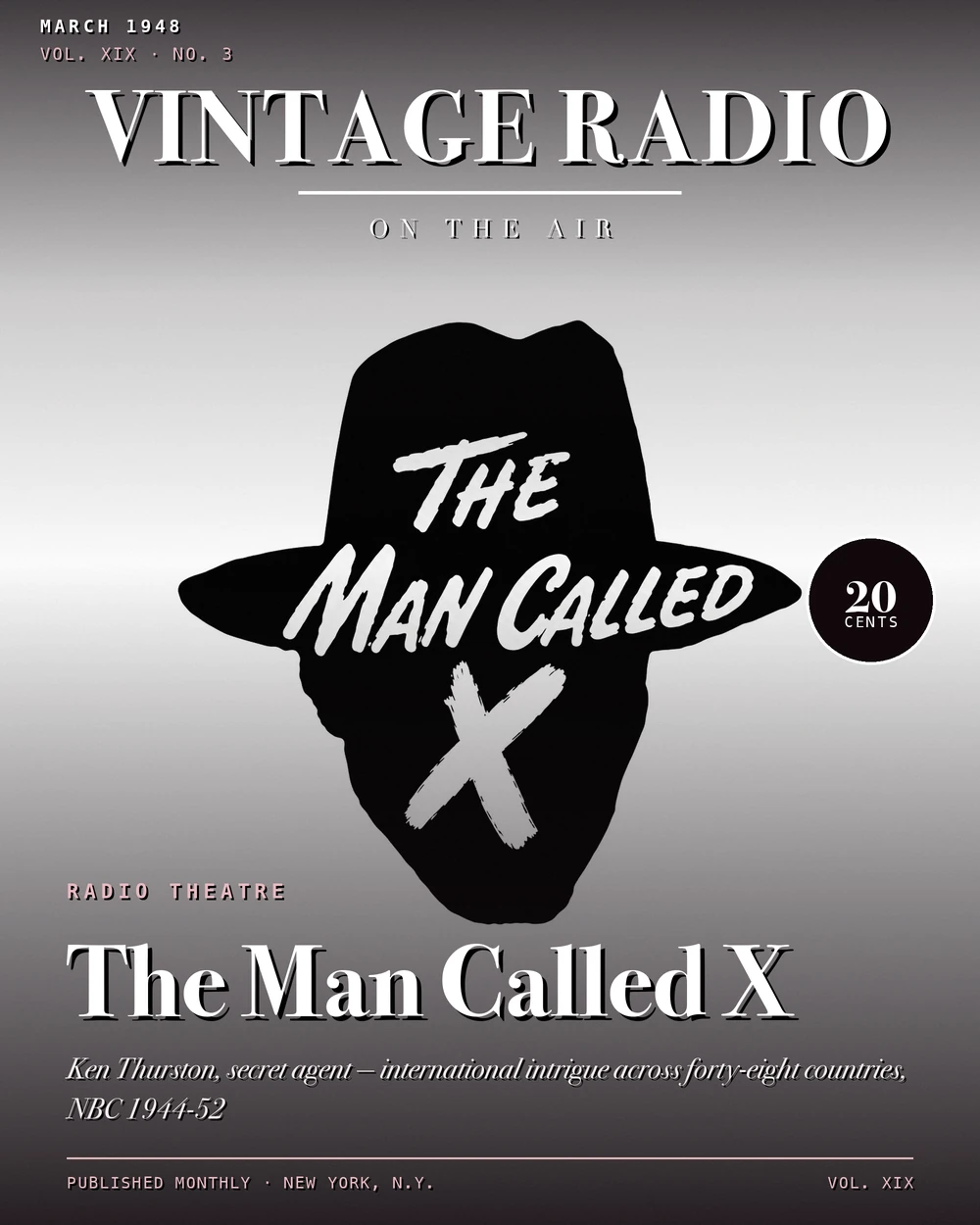
The Man Called X
The Show and What It Was
Few radio adventure series packed as much geography into a single premise as The Man Called X. The show followed Ken Thurston, described on air as "an international troubleshooter sent wherever intrigue lurked and danger was the byword" — a nation-hopping operative who turned up in India, Monte Carlo, and anywhere else the plot required a suave man with no fixed address. The series premiered on CBS on July 10, 1944, and in one form or another kept running until May 20, 1952, bouncing across three networks and collecting a half-dozen different sponsors along the way.
The show had an unusual origin for a globe-trotting spy drama. It started life as an FBI adventure series before the premise evolved outward, and the man behind it had an unusual background to match. Creator Jay Richard Kennedy — born Samuel Richard Solomonick in the East Bronx in 1911 — was a former FBI agent and OSS operative who had also done time at the Bureau of Narcotics, and he drew directly on that experience in building the show. He first wrote a Spanish-language pro-American, anti-Fascist propaganda program called El Mysterioso for State Department broadcast into Latin America, then reworked the material for American audiences as The Man Called X. The original eight-week 1944 CBS run was closer to a detective drama than a spy series — Thurston came across as "a private operative who was more detective than secret agent," and the early episodes carried a light comedic touch. Once he shed the domestic-bureau setup and became a wandering international agent, the show found the identity it kept for the rest of its run.
Announcer John McIntire set the tone in 1944 with a descriptive motif calling Thurston "the man who crosses the ocean as readily as you and I cross town." That line was later refined into the version audiences came to recognize: "Wherever there is mystery, intrigue, romance, in all the strange and dangerous places of the world, there you will find The Man Called X." The motif was effective enough that it was later lifted almost literally for the series Dangerous Assignment — about as direct a compliment as radio history offers.
Herbert Marshall and the Character He Played
The casting of Herbert Marshall as Ken Thurston shaped everything about how the show sounded. Marshall was a British actor who brought a particular kind of smoothness to the role — unhurried, worldly, comfortable in rooms where the other people weren't entirely trustworthy. Thurston's cases regularly featured mysterious women with shady pasts, which suited Marshall's manner well. He played the character across the full span of the series, and the voice became inseparable from the premise: a man who could land in a foreign city, size up a dangerous situation, and proceed without appearing rattled.
Marshall carried a remarkable personal history into the role. He had been shot in the left knee by a sniper at the Second Battle of Arras in April 1917, and after a string of operations the leg was amputated; he spent thirteen months in the hospital and largely concealed the prosthetic for the rest of his career. The concealment was thorough enough that when King George V visited St. Thomas' Hospital during his recovery and was asked to identify the artificial leg, the King picked the wrong one. In May 1951 Marshall underwent surgery for a pulmonary embolism and was temporarily replaced on the show during his convalescence by Van Heflin, John Lund, and Joseph Cotten — a stand-in lineup that suggests how seriously the production took the matter of who could carry Thurston's voice.
Alongside Marshall, Leon Belasco played a recurring character named Pegon Zeldschmidt — Thurston's friendly nemesis, a figure with "a streak of larceny in his soul" who managed to stay just inside the law and was willing to help if the price was right. The role had originated in 1944 with Hans Conried, who played the character then spelled Egon Zellschmidt; Mary Jane Croft also appeared in that first season as Thurston's reporter fiancée Nancy Bessington. When the show moved to the Blue Network in September 1944, Conried and Croft departed, the character was renamed, and Belasco took the part for the duration. Belasco himself had an unlikely path into radio: born Leonid Berladsky in Odessa, he trained as a violinist in Japan and Manchuria, briefly served as concertmaster of a Tokyo orchestra, and led the band that introduced the Andrews Sisters to American audiences before settling into film and radio character work.
The supporting cast drew from the deep bench of Hollywood radio talent. Joan Banks, Will Wright, Peter Leeds, Harry Lang, Carleton Young, Barbara Fuller, William Conrad, Lou Merrill, Stanley Waxman, B. J. Thompson, and George Niese all appeared across the run, with John Dehner, Gloria Blondell, Ed Begley, and Howard McNear joining the Radio Row regulars during the 1950–52 NBC revival. William Robson produced and directed for CBS in 1944, with Jack Johnstone handling much of the rest of the run and Dee Engelbach coming in during the later years. Johnstone directed the show before a live studio audience — an unusual choice for a secretive espionage drama. Milton Merlin, Sidney Marshall, and Stephen Longstreet supplied scripts. The musical direction changed with the network: Gordon Jenkins led the orchestra during the first CBS run, Claude Sweeten and Felix Mills through 1944 and 1945, Milton Charles supplying background at various points, and Johnny Green for the 1947–48 CBS period.
A Show That Moved Around
The network history of The Man Called X is complicated enough to be worth tracing. The first CBS run lasted only from July 10 to August 28, 1944 — Monday nights at 9:30, with Lockheed Aircraft as sponsor and the show filling in for the vacationing Lux Radio Theatre. The show then moved to the Blue Network on September 9, 1944, still sponsored by Lockheed, running Saturday nights at 10:30 until March 3, 1945.
From there the show turned up on NBC for two consecutive summers — June to September 1945, then June to September 1946 — both times on Tuesdays at 10, both times as a summer substitute for Bob Hope, sponsored by Pepsodent. Summer substitute duty was a respectable position on the radio schedule of the era, but it meant the show came and went with the seasons rather than anchoring a regular slot.
The series returned to CBS on April 3, 1947, this time with General Motors sponsoring on behalf of Frigidaire. During this run the show started on Thursdays at 10 before moving to Sundays at 8:30, then ended September 26, 1948. After a two-year gap, NBC resurrected the show from October 13, 1950 through May 20, 1952, moving through a variety of timeslots — often Friday or Saturday nights, but without the stability of a fixed spot. Sponsors during this final stretch included Ford Motors, RCA Victor, Whitehall Pharmacal, Liggett and Myers Tobacco, Chesterfield, and Anacin at various points.
That's four network stints, at least eight sponsors, and a run that stretched nearly eight years with significant gaps. The show was viable enough to keep getting picked up, but it never settled into the kind of permanent weekly slot that made some adventure series into long-running institutions.
Why It Held Together
What gave The Man Called X its consistency across all that shuffling was the combination of Marshall's voice and the premise. The international troubleshooter format was flexible enough to accommodate almost any setting — a story set in India required no different production resources than one set in a European city, since the show was building its exotic locations in sound and dialogue rather than on location. Surviving episode titles and plot summaries make the range clear: Thurston turned up in Greece, Hawaii, Guatemala, Australia, the Philippines, Egypt, Antarctica, Venezuela, Luxembourg, Peru, and Austria, dealing with smuggled guns, radioactive material, rogue scientists, leaked secrets, sabotage, and foreign revolutionaries. The Cold War supplied an endless catalogue of threats, and the formula of mysterious women, dangerous strangers, and Thurston arriving in a foreign place with his wits as his main asset could be reset and replayed across more than a hundred episodes without wearing out.
The descriptive motif that ran through the series did real work in establishing the show's identity quickly for any listener who tuned in without prior context. By the time the line had been refined from its original McIntire version to the fuller formulation used in later years, it had become one of the more recognizable opening signatures in the adventure genre. Kennedy himself adapted the property for television in 1956, working with Ziv to produce a syndicated series starring Barry Sullivan as Thurston; Ladislas Farago, a real-life intelligence agent and successful author, served as technical supervisor and partly inspired the TV version of the character. The television run lasted 39 episodes before rising production costs ended it — a modest afterlife for a radio property that had spent the better part of a decade proving the international-troubleshooter premise could carry a show across any network willing to schedule it.